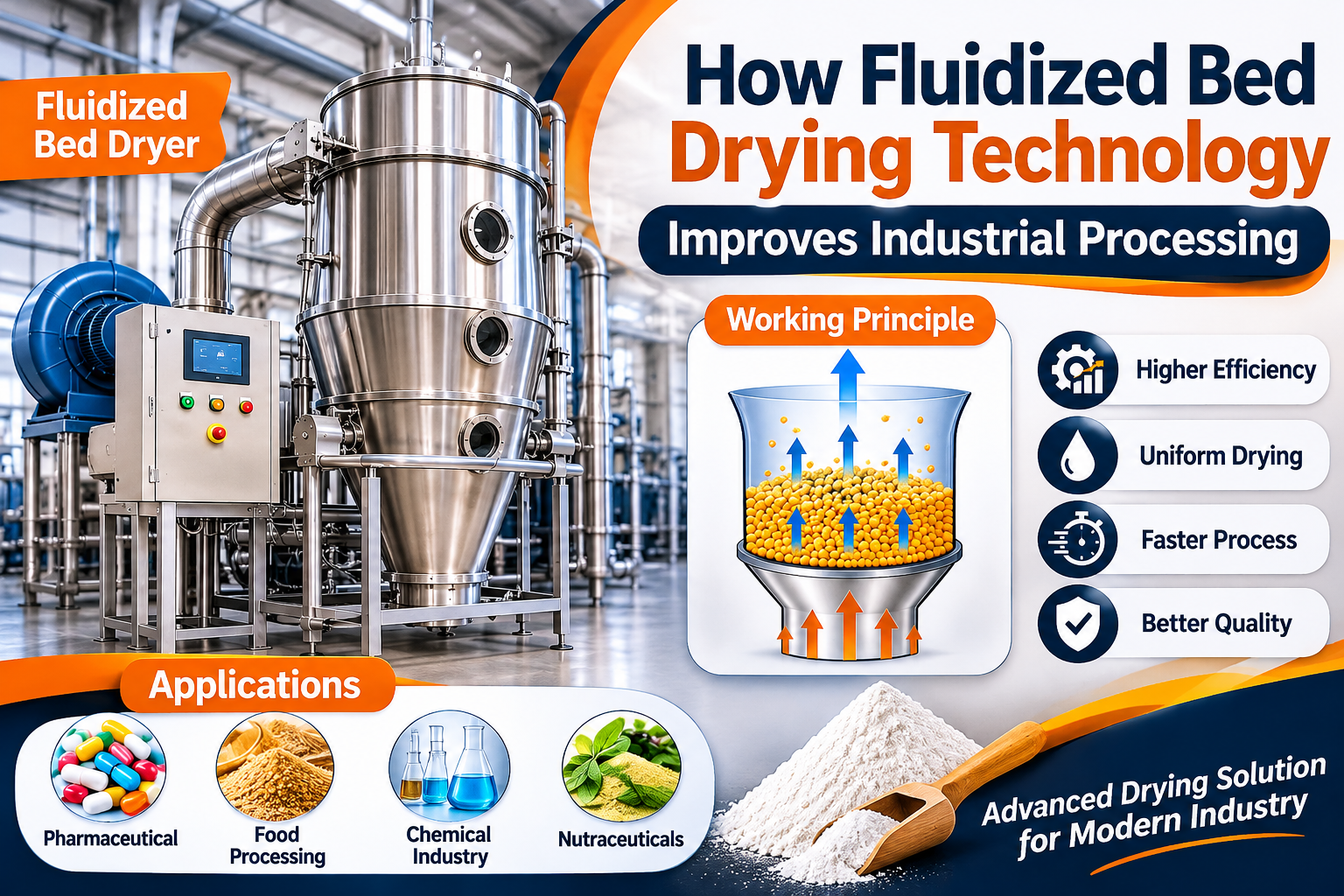
Fluidized Bed Dryer technology plays an important role in modern industrial processing by removing moisture from powders, granules and small solid particles through controlled hot-air circulation.
It is widely used in pharmaceutical manufacturing, food processing, chemical production and other industries where consistent moisture levels are important for product quality.
Industrial products often require controlled drying before they can move to the next manufacturing stage. Excess moisture can affect product stability, storage life, texture, flow properties and overall performance. Traditional drying methods may take longer or produce uneven results, depending on the material and operating conditions.
Modern air-based drying systems help manufacturers improve production efficiency while maintaining product quality. Understanding their working principles, components, applications and operating requirements can help businesses select suitable equipment for their manufacturing needs.
Fluidized Bed Dryer: Understanding the Working Principle
The working principle is based on the movement of heated air through a bed of wet particles. When air enters the drying chamber from below at an appropriate velocity it lifts and separates the particles. The material begins to behave like a fluid, allowing hot air to come into contact with a large surface area.
This interaction supports heat transfer and moisture evaporation. As the heated air passes around the particles, moisture moves from the material into the surrounding air. The moisture-containing air is then removed through the exhaust system.
The drying process depends on several factors, including air temperature, airflow velocity, material properties, particle size and initial moisture content. These parameters must be controlled to achieve consistent results.
Unlike some conventional drying methods this technology allows particles to move continuously within the drying chamber. This movement helps reduce uneven drying and supports efficient heat distribution.
How the Drying Process Works
The drying process generally involves several stages. Although equipment designs can vary between manufacturers the basic operating sequence remains similar.
Loading the wet material
Wet granules or particles are placed inside the product container. The material should be distributed properly to support uniform airflow during operation.
Air filtration and heating
Fresh air enters the air handling system, where filters remove unwanted particles. The air is then heated to the required process temperature before entering the drying chamber.
Air distribution
A perforated plate or air distribution system spreads the incoming air across the material bed. Proper distribution helps prevent uneven airflow and localized wet areas.
Particle movement
As air moves upward, it creates sufficient force to lift and separate the particles. This movement increases contact between the heated air and the wet material.
Moisture removal
Heat transfers from the air to the particles, causing moisture to evaporate. The moisture is carried away through the exhaust airflow.
Drying completion and discharge
The process continues until the material reaches its required moisture level. After the drying cycle, the equipment is stopped and the dried product is collected according to the operating procedure.
Main Components and Their Functions
Industrial drying equipment contains several interconnected components. Each part contributes to the safe and effective operation of the system.
Air Handling Unit
The air handling unit supplies clean and heated air to the drying chamber. It commonly includes air filters, heating elements or heating coils, fans and related controls.
Product Container
The product container holds the wet granules or particles during the drying process. Its design supports airflow through the material bed.
Air Distribution Plate
This component distributes incoming air across the bottom of the product container. Proper air distribution helps maintain stable particle movement.
Expansion Chamber
The expansion chamber provides space for particles and airflow to expand above the product bed. It also helps reduce the amount of product carried towards the exhaust system.
Filter Bags
Filter bags capture fine particles that may travel upward with the air. They help reduce product loss and prevent excessive dust from entering the exhaust system.
Exhaust Fan
The exhaust fan removes humid air from the system and maintains the required airflow through the chamber.
Control Panel
The control panel allows operators to monitor and adjust process conditions such as temperature, airflow, operating time and other equipment settings.
Different Types of Industrial Drying Systems
Different manufacturing operations require different equipment designs. The selection depends on production capacity, material characteristics, available space, and the required drying conditions.
Vertical Systems
Vertical designs are commonly used in pharmaceutical manufacturing and batch-processing operations. They generally have a compact arrangement and are suitable for drying granules in controlled production batches.
Horizontal Systems
A horizontal fluidized bed dryer uses a horizontal arrangement to move material through different drying zones. Depending on its design it can support continuous processing and controlled movement of products.
A horizontal fluid bed dryer may be selected for applications where continuous production and larger processing volumes are required.
Laboratory Systems
A laboratory fluid bed dryer is designed for research, product development, and small-scale testing. It allows manufacturers and researchers to study drying behaviour before moving to larger production equipment.
Static Systems
A static fluid bed dryer generally uses a stationary product bed while heated air passes through the material. Its suitability depends on the characteristics of the particles and the required processing conditions.
How a Fluidized Bed Dryer Improves Industrial Processing
Modern manufacturing requires equipment that can deliver consistent results while supporting production efficiency. This technology offers several advantages when it is correctly designed and operated.
Improved Heat Transfer
The continuous movement of particles increases their contact with heated air. This supports effective heat transfer and helps remove moisture from different parts of the material.
More Uniform Drying
Proper airflow distribution helps reduce differences in moisture levels between particles. Uniform drying is particularly important when products require specific moisture limits before further processing.
Reduced Processing Time
The large contact area between air and particles can support faster moisture removal compared with some conventional drying methods. Actual drying time depends on material properties and process settings.
Better Product Handling
The movement of particles during processing can reduce the need for repeated manual handling. This may improve production workflow and reduce unnecessary product transfer.
Improved Production Efficiency
Automated controls, temperature monitoring, and controlled airflow allow operators to manage the process more consistently. This can help manufacturers improve batch repeatability.
Versatile Industrial Applications
The equipment can process different types of powders and granules, provided that their physical properties are suitable for fluidization. Manufacturers must assess particle size, density, moisture content and heat sensitivity before selecting a system.
Industrial Applications Across Different Sectors
These drying systems are used in several industries because moisture control is an important part of manufacturing.
Pharmaceutical Manufacturing
The fluid bed dryer pharmaceutical process is commonly associated with drying wet granules used in tablet and capsule production. Controlled moisture levels help prepare granules for subsequent manufacturing stages.
In pharmaceutical production, drying conditions must be established through suitable process development and validation. Operators also need to follow approved cleaning, documentation and quality-control procedures.
Food Processing
Food manufacturers use air-based drying systems for suitable ingredients, granules and powdered materials. Examples may include food additives, instant beverage ingredients and other products that require controlled moisture removal.
Chemical Manufacturing
Chemical producers may use these systems to dry granulated or particulate materials before packaging, storage or additional processing. Material compatibility and temperature sensitivity must be considered.
Nutraceutical and Herbal Products
Certain nutraceutical ingredients and herbal granules require controlled drying to maintain suitable physical properties. The selected process should account for the sensitivity of the active ingredients.
Agricultural and Industrial Materials
Some agricultural and industrial products also require moisture reduction before storage or further manufacturing. Equipment selection depends on particle characteristics and the required final moisture content.
Main Operating Parameters
Successful drying requires proper control of operating conditions. Incorrect settings may result in poor drying performance, product loss or material damage.
Inlet air temperature: This determines the temperature of the air entering the chamber. The correct setting depends on the material’s thermal sensitivity.
Airflow velocity: Air velocity must be sufficient to support particle movement without carrying excessive material into the filters.
Initial moisture content: Materials with higher moisture levels may require longer processing times or different operating conditions.
Particle size and density: Larger or heavier particles may behave differently from smaller, lighter particles during fluidization.
Drying time: The process duration should be based on the required moisture endpoint rather than an arbitrary fixed time.
Exhaust air conditions: Monitoring exhaust temperature and humidity can provide useful information about the drying process.
Equipment Selection, Capacity and Cost Considerations
Choosing suitable equipment requires more than comparing machine prices. Businesses should consider production requirements, product characteristics, operating costs, maintenance needs, and regulatory expectations.
A fluid bed machine should be selected according to the intended application and production scale. Small research facilities may need compact equipment while large manufacturing plants may require systems designed for higher throughput.
The fluid bed equipment configuration can include different heating arrangements, filtration systems, control options, and product-handling features. These choices affect the machine’s suitability for specific materials.
The fluid bed dryer cost varies according to capacity, construction material, automation level, heating system, filtration design, and manufacturer specifications. Installation, utilities, spare parts, and maintenance should also be included when estimating the total investment.
Before purchasing, manufacturers should compare technical specifications, request product demonstrations where possible, and review after-sales support.
A fluidized bed dryer manufacturer should be able to provide equipment specifications, operating documentation, technical support, and information about applicable quality and safety requirements.
Safety, Cleaning and Maintenance
Routine maintenance is essential for reliable industrial operation. Dust accumulation, damaged filters, poor airflow, or worn components can reduce equipment performance.
Operators should inspect filter bags, fans, heating components, air distribution plates and seals according to the maintenance schedule. Damaged filters should be replaced when necessary.
Cleaning procedures should be appropriate for the processed material. Pharmaceutical facilities may require documented cleaning procedures to prevent cross-contamination between batches.
Electrical systems, temperature controls, and safety interlocks should also be inspected regularly. Materials that generate combustible dust require an appropriate hazard assessment and suitable dust-control and explosion-protection measures.
Staff should receive training on loading, unloading, operating, cleaning and emergency procedures. Maintenance activities should follow the manufacturer’s instructions and the facility’s safety requirements.
Common Challenges and Practical Solutions
Although modern drying equipment offers several advantages, operating challenges can occur.
Uneven drying: This may result from poor airflow distribution, excessive product loading, or inconsistent particle sizes. Reviewing the loading procedure and airflow settings can help.
Filter blockage: Fine particles may accumulate in filter bags and restrict airflow. Regular inspection and suitable filter cleaning procedures are important.
Product loss: Excessive airflow may carry particles into the filtration system. Air velocity should be adjusted according to the material’s characteristics.
Overheating: Excessive temperatures can damage heat-sensitive materials. Temperature monitoring and suitable control limits help reduce this risk.
Inconsistent results: Variations in starting moisture, batch size and operating conditions may affect the final product. Standardized procedures and process monitoring can improve consistency.
Sum up
Industrial drying plays an important role in maintaining product quality, production efficiency and reliable manufacturing operations. A Fluidized Bed Dryer offers controlled moisture removal through the interaction of heated air and moving particles. Its applications extend across pharmaceutical, food, chemical and other industrial sectors.
Selecting the right equipment requires careful consideration of material properties, production capacity, airflow, temperature, maintenance and safety requirements. With appropriate process controls and regular servicing, manufacturers can achieve consistent drying performance and improve their overall production workflow.
Frequently Asked Questions (FAQs)
- What is a Fluidized Bed Dryer?
It is an industrial drying system that uses heated air to suspend and move wet particles, allowing moisture to evaporate from powders and granules. - What is the working principle of a fluid bed dryer?
Its principle involves passing heated air upward through a bed of wet particles. The air lifts and separates the particles, increasing contact between the material and the heated air to support moisture removal. - What are the main uses of this drying equipment?
Common applications include drying pharmaceutical granules, suitable food ingredients, chemical particles, nutraceutical materials and other products that require controlled moisture reduction. - What are the different types of fluidized drying systems?
Common designs include vertical batch systems, horizontal continuous systems, laboratory-scale units, and static configurations. The suitable type depends on the material and production requirements. - How often should industrial dryers be serviced?
Service frequency depends on the manufacturer’s recommendations, operating hours, production environment, and equipment condition. Routine inspections should be performed according to a documented maintenance schedule, with more detailed servicing at the specified intervals. - How does this drying process work?
Filtered air is heated and passed upward through wet particles. The airflow suspends the particles, transfers heat and carries evaporated moisture away through the exhaust system. - What determines the capacity of an industrial drying system?
Capacity depends on the size of the drying chamber, material properties, batch size, initial and final moisture levels, airflow, heating capability, and required processing time. Manufacturers should calculate capacity based on the actual product and operating conditions.
About the Author