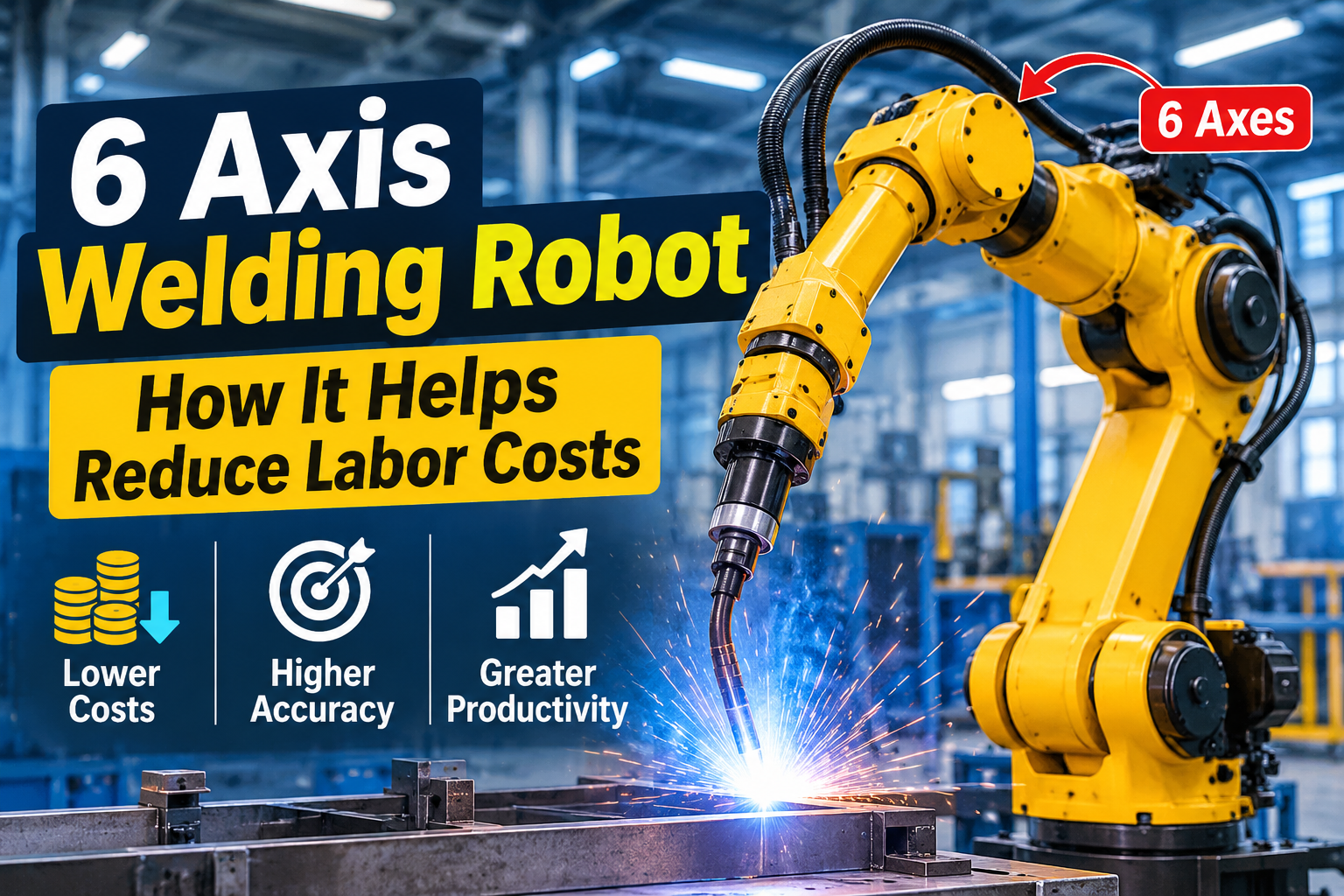
6 axis welding robot technology helps manufacturers reduce labor costs, improve welding accuracy, and increase production efficiency. It automates repetitive welding tasks, reduces manual work and maintains consistent results.
Unlike traditional welding, robotic systems can operate across multiple shifts, reduce material waste and improve productivity. This allows manufacturers to control expenses and use skilled workers for other important tasks.
How a 6 Axis Welding Robot Reduces Labor Costs
A 6 axis welding robot can perform repetitive welding operations with programmed movements. It can work on different metal parts, follow predefined welding paths and maintain consistent movement throughout production.
This automation reduces the need for workers to perform every welding task manually. Instead, employees can supervise robotic operations, prepare materials, inspect finished products and manage production activities.
Here are the main ways robotic welding helps businesses reduce labor expenses.
Reduces Manual Labor Requirements
Manual welding requires trained workers to handle welding equipment and complete each operation. Large manufacturing facilities may need several welders to maintain production targets.
Robotic welding reduces this workload by performing repetitive welding operations automatically. One trained operator can supervise a robotic cell, depending on the system design and production requirements.
This approach helps manufacturers use their workforce more efficiently. Businesses can assign employees to quality control, machine monitoring, maintenance and other productive tasks.
Increases Production Speed
Production speed directly affects manufacturing costs. Slow welding operations can increase labor hours and delay product delivery.
A welding robot follows programmed instructions and repeats welding movements without unnecessary interruptions. It can maintain a consistent working speed and complete repetitive jobs efficiently.
Faster production allows manufacturers to complete more work within scheduled operating hours. Businesses can also reduce the labor hours required for each finished product.
Reduces Welding Errors and Material Waste
Manual welding can produce inconsistent results when workers face fatigue, changing conditions or difficult welding positions. These problems may create defects that require repairs or replacement materials.
A robotic welding system follows programmed paths and controlled movements. Proper programming helps the robot maintain consistent torch positioning, speed and welding parameters.
This consistency can reduce common welding defects and lower material waste. Businesses also spend less time correcting avoidable mistakes.
Supports Multiple Production Shifts
Many factories operate during extended hours to meet customer demand. Managing several shifts can increase labor expenses because businesses need workers for different operating periods.
Robotic welding systems can support long production schedules when manufacturers provide suitable maintenance, supervision and safety controls.
A robot does not experience human fatigue although it still needs inspections and maintenance. This capability helps factories maintain production during extended operating hours without increasing welding labor at the same rate as manual processes.
What Are the 6 Axes of a Robot?
The six axes describe the different directions in which an industrial robot can move. These movements allow the robot to position its welding torch around a workpiece.
The what are the 6 axis of a robot question often comes up when manufacturers compare industrial robotic systems.
The six axes generally include:
- Axis 1 – Base Rotation: Rotates the robot around its base.
- Axis 2 – Shoulder Movement: Moves the robot arm forward and backward.
- Axis 3 – Elbow Movement: Extends or folds the robot arm.
- Axis 4 – Wrist Rotation: Rotates the wrist section.
- Axis 5 – Wrist Bend: Changes the angle of the welding tool.
- Axis 6 – Tool Rotation: Rotates the welding torch to achieve the required orientation.
Key Points to Know:These movements give the robot flexibility when it handles complex welding positions. The exact movement and joint arrangement can vary between robot models.
Why Are Robots Used for Welding?
The why are robots used for welding questions has several practical answers. Manufacturers use welding robots because they can improve consistency, increase production speed, and reduce repetitive manual work.
Robotic welding offers several benefits:
- Consistent Quality: Robots repeat programmed movements with high precision.
- Higher Productivity: Automated systems can complete repetitive tasks efficiently.
- Reduced Labor Pressure: Employees can focus on supervision and inspection.
- Better Repeatability: Robots maintain similar welding paths across production batches.
- Complex Positioning: Multi-axis arms can reach different angles around metal components.
- Reduced Exposure: Remote operation can reduce direct worker exposure to welding fumes, heat, and sparks when the cell has suitable extraction and guarding.
Key Points to Know:These benefits make robotic welding useful in automotive manufacturing, metal fabrication, heavy equipment production and other industrial applications.
How Welding Robots Improve Workplace Safety
Welding involves several hazards, including high temperatures, sparks, fumes, electrical risks and moving equipment. Manufacturers must control these hazards to protect employees.
The question why are robots dangerous to anyone working within the robot’s working volume welding highlights an important safety issue.
A robot’s working volume is the area its arm can reach during operation. Anyone who enters this area without proper protection may face serious injury.
A moving robot can strike, trap or crush a person. Its welding torch can also create burns, sparks and other hazards. Unexpected movements may increase these risks when workers enter an active robotic cell.
Businesses can improve safety through the following measures:
- Install physical safety fences around robotic work areas.
- Use interlocked access doors to stop robot movement when someone enters.
- Install suitable emergency stop controls.
- Use light curtains or safety scanners where appropriate.
- Train employees to follow safe operating procedures.
- Apply lockout/tagout procedures during maintenance.
- Keep welding fumes under control with suitable ventilation and extraction.
Key Points to Know:Manufacturers should conduct a risk assessment before installing or modifying a robotic welding cell. Proper guarding and safety procedures help protect employees while allowing robots to operate efficiently.
What Are the 6 Axes on a CNC Machine?
The what are the 6 axis on a cnc machine question relates to another type of industrial equipment.
A CNC machine uses computer-controlled movements to cut, drill, shape or finish materials. A six-axis CNC machine can move a cutting tool or workpiece along multiple linear and rotational directions.
The common axes include:
- X-axis: Left and right movement.
- Y-axis: Forward and backward movement.
- Z-axis: Up and down movement.
- A-axis: Rotation around the X-axis.
- B-axis: Rotation around the Y-axis.
- C-axis: Rotation around the Z-axis.
Important Things to Know:A six-axis CNC machine and a six-axis welding robot do not perform the same job. CNC machines mainly handle machining operations while welding robots join metal components. However both systems use multiple controlled axes to perform complex industrial movements.
Popular Welding Robot Brands
Manufacturers should compare robot brands before investing in an automated welding system. Different brands offer different robot models, payload capacities, reach, software and application support.
Some established industrial robot manufacturers include:
FANUC
<Entity value=”FANUC” category=”brand” disambig=”Industrial robotics and factory automation manufacturer”/> offers industrial robots and automation solutions for manufacturing. Its robotic systems support applications such as arc welding and material handling.
ABB
< Entity value=”ABB” category=”brand” disambig=”Industrial robotics and automation technology company”/> provides industrial robots and automation technologies. Manufacturers use its robotic solutions for welding and other production processes.
Yaskawa Motoman
< Entity value=”Yaskawa Motoman” category=”brand” disambig=”Industrial robot and automation product brand”/> offers robotic systems for industrial welding applications. Its solutions support automated production and repetitive welding operations.
KUKA
< Entity value=”KUKA” category=”brand” disambig=”Industrial robotics and automation manufacturer”/> develops industrial robots and automation systems for manufacturing. Its product range includes robotic solutions for welding applications.
Businesses should compare technical specifications, service availability, programming requirements and total ownership costs before selecting a manufacturer.
Important Features to Consider in Robotic Welding Systems
A robotic welding system requires an initial investment. Manufacturers should evaluate their production requirements before purchasing equipment.
Important factors include:
- Production Volume: Check how many parts the factory needs to weld daily. High-volume production may offer greater opportunities for automation.
- Welding Requirements: Identify the materials, joint types, welding positions, and processes involved.
- Robot Reach and Payload: Choose a robot that can reach the required welding positions and carry the welding equipment safely.
- Installation Costs: Consider the robot, welding power source, fixtures, safety equipment, programming, and integration expenses.
- Maintenance Requirements: Review service schedules, spare parts, and technical support.
- Employee Training: Ensure operators and maintenance staff receive suitable training.
These factors help businesses select a system that matches their production needs and budget.
How to Calculate Labor Cost Savings
Businesses should compare the total cost of manual welding with the total cost of robotic welding before making an investment.
For manual welding, calculate wages, overtime, benefits, training and other workforce expenses.
For robotic welding, include equipment costs, installation, programming, maintenance, energy consumption and operator wages.
Then compare the cost per finished part.
For example a robotic system may require a higher initial investment but reduce labor hours and rework over time. The actual savings depend on production volume, operating schedules, welding complexity and equipment utilization.
A proper cost analysis helps businesses understand the potential return on investment instead of relying on general claims about automation.
Sum up
A 6 axis welding robot helps manufacturers reduce labor costs by automating repetitive welding operations, improving production consistency and reducing avoidable rework. It also allows employees to focus on supervision, inspection and other important production activities.
Businesses should evaluate production volume, equipment costs, safety requirements and maintenance needs before investing in robotic welding. With proper planning and training, robotic welding can support efficient manufacturing and long-term cost control.
How does a 6 axis welding robot reduce labor costs?
It automates repetitive welding tasks, reduces manual work, minimizes material waste and helps manufacturers increase production.
- What industries use 6 axis welding robots?
Automotive, aerospace, shipbuilding, metal fabrication and heavy machinery industries commonly use these robots. - Are 6 axis welding robots safe to operate?
Yes. when manufacturers install proper safety systems, protective barriers, emergency stops and follow workplace safety procedures. - What materials can a 6 axis welding robot weld?
Depending on its welding process and setup it can weld materials such as carbon steel, stainless steel and aluminum.
About the Author