
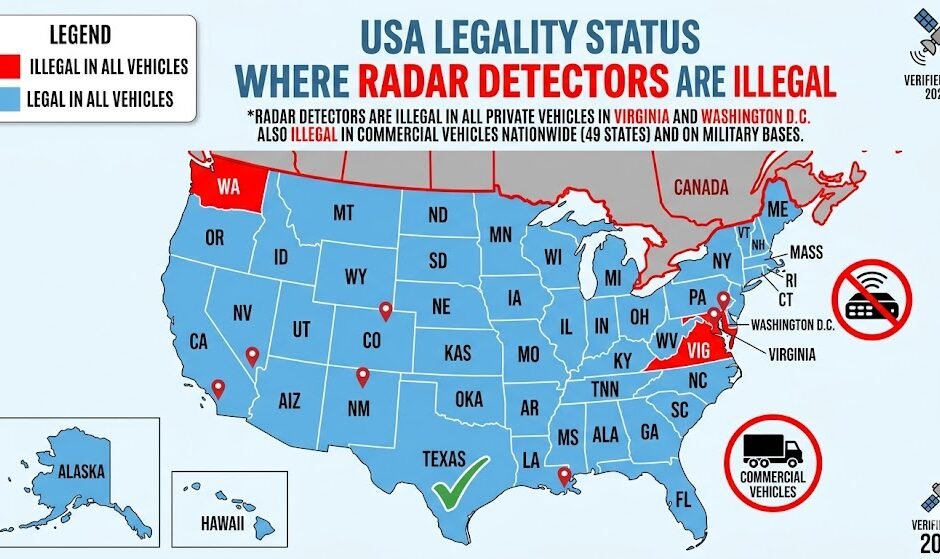

Radar detectors have become popular tools among drivers who want to avoid speeding tickets and stay alert on the road. These devices detect radio waves emitted by police radar guns, giving drivers a warning before they approach speed enforcement areas. While radar detectors are legal in many parts of the United States, some states and regions have strict laws prohibiting their use. Understanding where radar detectors are illegal is important for anyone planning to travel across state lines.
This article tells the states where radar detectors are illegal and explains the reasons behind these laws and highlights what drivers should consider before using one.
1:What are Radar Detectors?
A radar detector is an electronic device designed to identify radio signals from speed detection equipment used by law enforcement. Police officers commonly use radar guns or laser devices to measure a vehicle’s speed. When a radar detector picks up these signals it alerts the driver so they can reduce speed.
Drivers often rely on radar detectors to stay within speed limits and avoid fines. However, authorities in certain regions view these devices as tools that encourage unsafe driving behavior. As a result, they have imposed restrictions or complete bans.
2:States Where Radar Detectors Are Illegal
In the United States, radar detector laws vary by state. While most states allow their use in private vehicles, a few have banned them entirely.
Virginia
Virginia enforces one of the strictest bans on radar detectors. The state prohibits the use of radar detectors in all types of vehicles. Law enforcement officers can confiscate the device if they find it in use. Although drivers are allowed to possess a radar detector, they cannot operate it while driving.
Virginia authorities use radar detector detectors (RDDs) to identify drivers using these devices. If caught, drivers may face fines, although the device is usually returned after the incident.
Washington, D.C.
Radar detectors are also illegal in Washington, D.C. Similar to Virginia, drivers cannot use these devices within the district. The law applies to all vehicles, and penalties may include fines and confiscation.
3:Federal Restrictions on Radar Detectors
Even though most states allow radar detectors, federal law imposes restrictions on certain types of vehicles.
Commercial Vehicles
The federal government prohibits radar detectors in commercial vehicles weighing over 10,000 pounds. This rule applies across all states, regardless of local laws. Truck drivers and commercial operators must comply with this regulation or risk penalties.
The restriction aims to promote road safety, as large vehicles pose greater risks in accidents. Authorities believe that banning radar detectors in commercial vehicles encourages responsible driving.
4:Why Do Some States Ban Radar Detectors?
Different states have different reasons for banning radar detectors. These laws usually focus on safety concerns and traffic enforcement effectiveness.
Promoting Road Safety
Authorities argue that radar detectors encourage drivers to exceed speed limits. Drivers may rely on the device to warn them instead of following traffic laws. This behavior can lead to reckless driving and increase the risk of accidents.
Supporting Law Enforcement
Police departments rely on radar and laser devices to monitor speed and enforce traffic laws. Radar detectors can interfere with this process by allowing drivers to slow down only when they detect enforcement, rather than maintaining safe speeds at all times.
Preventing Speeding Culture
Some regions aim to discourage a culture where drivers actively try to avoid detection instead of obeying rules. By banning radar detectors, these areas promote consistent compliance with speed limits.
5:States Where Radar Detectors Are Legal
While only a few states ban radar detectors, the majority allow their use in private vehicles. Drivers in these states can legally install and operate radar detectors without facing penalties.
However, legality does not mean unrestricted use. Drivers must still follow traffic laws and avoid obstructing their view with mounted devices. Improper placement of a radar detector on the windshield may result in a separate violation.
6:Driver Safety and Legal Tips
Even in states where radar detectors are legal, drivers should consider several important factors before using one.
Windshield Mounting Laws
Some states restrict objects attached to windshields. If a radar detector blocks the driver’s view, it may violate local laws. Drivers should install the device in a safe and compliant position.
Laser Detection Limitations
Radar detectors often struggle to detect laser-based speed guns effectively. Laser signals are narrow and difficult to pick up in time. Drivers should not rely solely on radar detectors for protection against speeding tickets.
Use of Radar Jammers
Radar jammers are different from radar detectors. These devices actively interfere with police radar signals. In many states, radar jammers are illegal and carry severe penalties. Drivers must understand the distinction and avoid using prohibited equipment.
7:Navigating Different State Laws
Drivers who frequently travel should pay close attention to radar detector laws in different states. A device that is legal in one state may be illegal in another.
For example, a driver traveling from Maryland to Virginia must turn off their radar detector before entering Virginia. Failure to do so may result in fines or confiscation.
Planning ahead and researching local laws can help drivers avoid unnecessary legal trouble.
8:Legal Action and Fines for Drivers
The consequences of using radar detectors in restricted areas vary by location. Common penalties include:
- Fines
- Confiscation of the device
- Possible points on the driver’s record (in some cases)
Key point to know:In Virginia, fines are relatively small, but repeated violations can still create inconvenience. Law enforcement officers may also use advanced technology to detect radar detector usage, making it difficult to avoid detection.
9:Role of Technology in Speed Control
As technology evolves, both radar detectors and law enforcement tools continue to improve.
Radar Detector Detectors (RDDs)
Police use RDDs to identify vehicles equipped with radar detectors. These devices can detect the signals emitted by radar detectors themselves. This technology is particularly common in states where radar detectors are banned.
Advanced Speed Detection Methods
Law enforcement agencies increasingly use laser guns and other advanced tools. These methods are harder for radar detectors to detect, reducing their effectiveness.
10:Tools and Methods Beyond Radar Detectors
Drivers who want to stay safe and avoid tickets can consider alternatives to radar detectors.
GPS-Based Alerts
Some navigation systems provide alerts about speed cameras and high-risk areas. These systems rely on databases rather than detecting signals.
Mobile Apps
Several mobile apps offer real-time traffic updates and speed trap alerts. These apps use community reporting to share information with other drivers.
Safe Driving Practices
The most reliable way to avoid speeding tickets is to follow traffic laws. Maintaining a safe speed and staying aware of road conditions ensures both safety and compliance.
11:Facts You Should Know About Radar Detectors
Many drivers have misunderstandings about radar detectors. Clearing up these misconceptions can help them make informed decisions.
Radar Detectors Make You Invisible
Radar detectors do not make a vehicle invisible to police radar. They only provide alerts, and sometimes those alerts come too late.
All States Ban Radar Detectors
Only a small number of states ban radar detectors. Most states allow them in private vehicles.
Radar Detectors Guarantee No Tickets
No device can guarantee that a driver will avoid speeding tickets. Law enforcement uses various methods that may bypass radar detection.
12:Legal Tips For Drivers
Drivers who choose to use radar detectors should follow these tips:
- Check local laws before using the device
- Turn off the detector in restricted areas
- Avoid using radar jammers
- Install the device safely without blocking the view
- Stay updated on changing regulations
By following these guidelines, drivers can reduce the risk of legal issues.
13:Changing Regulations and New Policies
Radar detector laws may continue to evolve as technology advances. Governments may introduce new regulations to address emerging challenges in traffic enforcement.
At the same time, manufacturers continue to develop more advanced devices with improved detection capabilities. This ongoing competition between technology and regulation will likely shape the future of radar detector usage.
Bottom Line
Radar detectors remain widely used tools for drivers, but their legality depends on location. In the United States and Virginia and Washington, D.C. have strict bans on radar detector use, while federal law prohibits them in commercial vehicles over 10,000 pounds.
Drivers must understand these laws and stay informed when traveling between states. While radar detectors can provide alerts they should not replace responsible driving habits. Following speed limits and staying attentive on the road remain the most effective ways to ensure safety and avoid penalties.
By understanding where radar detectors are illegal and how the laws apply and drivers can make smarter decisions and enjoy a safer driving experience.


유흥알바 밤알바 25 Sep 2026
Hey! Do you use Twitter? I’d like to follow you if that would be ok. I’m undoubtedly enjoying your blog and look forward to new posts.
pestoto 26 Sep 2026
I’d incessantly want to be update on new posts on this website , bookmarked! .
pestoto daftar 27 Sep 2026
Definitely, what a fantastic blog and educative posts, I definitely will bookmark your site.All the Best!
automotive technician course malaysia 28 Sep 2026
I like this web site so much, saved to fav. “American soldiers must be turned into lambs and eating them is tolerated.” by Muammar Qaddafi.
dewi11 28 Sep 2026
Someone essentially help to make seriously articles I would state. This is the very first time I frequented your website page and thus far? I amazed with the research you made to create this particular publish amazing. Excellent job!
recuperar conta gmail 28 Sep 2026
Heya i am for the first time here. I found this board and I find It truly helpful & it helped me out a lot. I’m hoping to offer something again and aid others such as you aided me.
gold bullion malaysia 29 Sep 2026
I’m still learning from you, while I’m trying to reach my goals. I definitely enjoy reading all that is written on your site.Keep the information coming. I loved it!
como configurar aplicativo IPTV 29 Sep 2026
It’s actually a nice and useful piece of info. I’m satisfied that you simply shared this helpful info with us. Please stay us up to date like this. Thanks for sharing.
sell gold near me 30 Sep 2026
Thanx for the effort, keep up the good work Great work, I am going to start a small Blog Engine course work using your site I hope you enjoy blogging with the popular BlogEngine.net.Thethoughts you express are really awesome. Hope you will right some more posts.
DMCA Meldung FSaved 30 Sep 2026
Thanks for all your work on this blog. Kate loves doing investigations and it is easy to see why. We all learn all relating to the lively tactic you deliver very useful techniques through your blog and as well recommend participation from visitors on the content plus my child is without a doubt starting to learn so much. Take advantage of the remaining portion of the new year. Your carrying out a fantastic job.
dewi11 30 Sep 2026
I have been absent for a while, but now I remember why I used to love this web site. Thank you, I will try and check back more often. How frequently you update your site?
bff quiz 30 Sep 2026
I conceive you have remarked some very interesting points, thankyou for the post.
ssd 500gb 30 Sep 2026
I’d need to test with you here. Which isn’t something I often do! I enjoy reading a put up that can make individuals think. Additionally, thanks for permitting me to remark!
parecer tecnico 30 Sep 2026
An interesting discussion is worth comment. I think that you should write more on this topic, it might not be a taboo subject but generally people are not enough to speak on such topics. To the next. Cheers
mystery diamond painting 1 Oct 2026
This is really interesting, You are a very skilled blogger. I have joined your rss feed and look forward to seeking more of your wonderful post. Also, I’ve shared your site in my social networks!
CBD Cream 1 Oct 2026
I think other website proprietors should take this internet site as an example , very clean and great user friendly layout.
HHC-O 1 Oct 2026
I’ve been absent for some time, but now I remember why I used to love this web site. Thanks, I will try and check back more frequently. How frequently you update your site?
Cannabinoid gummies 1 Oct 2026
Pretty! This was a really wonderful post. Thank you for your provided information.
Penetration testing and ethical hackers 1 Oct 2026
I was examining some of your posts on this internet site and I think this site is really informative! Retain posting.
empresa inca 1 Oct 2026
I have recently started a web site, the info you offer on this website has helped me greatly. Thank you for all of your time & work.
ducati valencia 1 Oct 2026
You are my aspiration, I own few web logs and sometimes run out from to brand : (.
ayuda TFG arquitectura 2 Oct 2026
I will immediately grasp your rss as I can not to find your e-mail subscription link or e-newsletter service. Do you have any? Please permit me recognise so that I may subscribe. Thanks.
ayuda PFG arquitectura 2 Oct 2026
Undeniably believe that which you said. Your favorite justification seemed to be on the net the easiest thing to be aware of. I say to you, I definitely get annoyed while people think about worries that they just don’t know about. You managed to hit the nail upon the top and also defined out the whole thing without having side-effects , people could take a signal. Will likely be back to get more. Thanks
av petit thouars 1775, lince 3 Oct 2026
Thanks , I’ve recently been searching for info about this subject for ages and yours is the best I have discovered till now. But, what about the conclusion? Are you sure about the source?
https://allmac.co.id 3 Oct 2026
Needed to send you a tiny note just to say thank you yet again for the wonderful opinions you have provided on this website. It has been generous of people like you to present without restraint what many of us would’ve made available for an e book to generate some cash on their own, particularly given that you might well have tried it in case you desired. The ideas in addition acted to be a easy way to comprehend many people have a similar dreams just like my very own to know the truth a lot more when considering this issue. Certainly there are a lot more pleasant sessions up front for individuals who examine your website.
ropa para sauna 3 Oct 2026
I would like to thnkx for the efforts you have put in writing this web site. I am hoping the same high-grade blog post from you in the upcoming as well. In fact your creative writing skills has inspired me to get my own website now. Actually the blogging is spreading its wings fast. Your write up is a great example of it.
lighting inc austin 3 Oct 2026
Howdy! This is my first comment here so I just wanted to give a quick shout out and say I genuinely enjoy reading your blog posts. Can you suggest any other blogs/websites/forums that deal with the same topics? Thanks for your time!
fashion ugc generator 3 Oct 2026
I believe this site has got some rattling superb information for everyone :D.
the general car insurance 4 Oct 2026
hi!,I love your writing so much! percentage we be in contact extra approximately your post on AOL? I need an expert in this space to unravel my problem. Maybe that is you! Taking a look forward to peer you.
akongcuan 6 Oct 2026
I believe this internet site has got some rattling fantastic information for everyone :D. “As ill-luck would have it.” by Miguel de Cervantes.
k2 herbal incense 6 Oct 2026
You should take part in a contest for one of the best blogs on the web. I will recommend this site!
free wordpress page builder 6 Oct 2026
Appreciate it for this post, I am a big big fan of this internet site would like to keep updated.
hptoto 6 Oct 2026
My partner and I stumbled over here coming from a different web address and thought I might check things out. I like what I see so now i’m following you. Look forward to exploring your web page yet again.
hptoto 6 Oct 2026
Hi, just required you to know I he added your site to my Google bookmarks due to your layout. But seriously, I believe your internet site has 1 in the freshest theme I??ve came across. It extremely helps make reading your blog significantly easier.
web hosting 6 Oct 2026
Hey there! I’ve been following your website for a long time now and finally got the courage to go ahead and give you a shout out from Humble Tx! Just wanted to tell you keep up the excellent work!
akongcuan 6 Oct 2026
I really like your blog.. very nice colors & theme. Did you create this website yourself or did you hire someone to do it for you? Plz reply as I’m looking to design my own blog and would like to know where u got this from. cheers
ทนายความเชียงใหม่ 7 Oct 2026
Thanks for your marvelous posting! I certainly enjoyed reading it, you happen to be a great author.I will ensure that I bookmark your blog and will come back someday. I want to encourage you to definitely continue your great posts, have a nice weekend!
situs toto slot 7 Oct 2026
I visited a lot of website but I conceive this one contains something special in it in it
hotbet77 alternatif 7 Oct 2026
This really answered my downside, thanks!
arvin browser 8 Oct 2026
Hi there! I just would like to give an enormous thumbs up for the nice information you’ve got here on this post. I shall be coming again to your blog for extra soon.
main duit 8 Oct 2026
I used to be recommended this web site via my cousin. I’m no longer positive whether or not this post is written by way of him as no one else recognise such specific about my problem. You are incredible! Thanks!
madhur matka trik zone 8 Oct 2026
Hi, I think your site might be having browser compatibility issues. When I look at your website in Safari, it looks fine but when opening in Internet Explorer, it has some overlapping. I just wanted to give you a quick heads up! Other then that, fantastic blog!
ughoki 8 Oct 2026
Excellent website. Lots of useful info here. I am sending it to some friends ans also sharing in delicious. And obviously, thanks for your effort!
click here 8 Oct 2026
I think other web site proprietors should take this web site as an model, very clean and great user genial style and design, as well as the content. You are an expert in this topic!
Chemical Etching Company 9 Oct 2026
I don’t ordinarily comment but I gotta say thankyou for the post on this one :D.
launchedhere.com 10 Oct 2026
Hello, Neat post. There’s a problem with your website in web explorer, might check this… IE nonetheless is the marketplace leader and a good element of other people will leave out your excellent writing due to this problem.
https://naverolaunch.com/ 10 Oct 2026
You made some decent points there. I seemed on the internet for the difficulty and found most individuals will go together with with your website.
whatislaunching.com 10 Oct 2026
Terrific work! This is the kind of info that are supposed to be shared across the web. Shame on the seek engines for now not positioning this publish upper! Come on over and visit my website . Thanks =)
jitu99 toto slot 10 Oct 2026
Dead indited articles, appreciate it for information .
https://startuplaunched.com/ 10 Oct 2026
Very superb info can be found on website. “Even if happiness forgets you a little bit, never completely forget about it.” by Donald Robert Perry Marquis.
bukiety z dostawą w Warszawie 10 Oct 2026
Hello, you used to write magnificent, but the last few posts have been kinda boringK I miss your tremendous writings. Past few posts are just a little out of track! come on!
https://www.permainanslotonline.net/ 10 Oct 2026
naturally like your website however you have to take a look at the spelling on quite a few of your posts. Many of them are rife with spelling issues and I in finding it very troublesome to tell the truth nevertheless I will certainly come back again.
Victorias Secret bags 11 Oct 2026
You are my inhalation, I own few blogs and infrequently run out from brand :). “Yet do I fear thy nature It is too full o’ the milk of human kindness.” by William Shakespeare.
klinik aborsi 11 Oct 2026
Howdy would you mind letting me know which web host you’re using? I’ve loaded your blog in 3 different web browsers and I must say this blog loads a lot quicker then most. Can you suggest a good hosting provider at a honest price? Many thanks, I appreciate it!
toto togel online 11 Oct 2026
Some really nice and utilitarian info on this site, besides I think the design has got superb features.
slot online 11 Oct 2026
Just a smiling visitor here to share the love (:, btw great style and design.
lgowin99 12 Oct 2026
Youre so cool! I dont suppose Ive read something like this before. So good to search out any person with some original thoughts on this subject. realy thank you for beginning this up. this web site is one thing that is wanted on the internet, somebody with slightly originality. helpful job for bringing one thing new to the internet!
senangslot 12 Oct 2026
Hello there! Do you know if they make any plugins to protect against hackers? I’m kinda paranoid about losing everything I’ve worked hard on. Any recommendations?
slot thailand 12 Oct 2026
Just wish to say your article is as astonishing. The clarity in your post is just excellent and i could assume you’re an expert on this subject. Well with your permission let me to grab your feed to keep updated with forthcoming post. Thanks a million and please continue the gratifying work.
tukang taman cimanggis 14 Oct 2026
It’s actually a great and helpful piece of information. I’m glad that you shared this helpful info with us. Please keep us up to date like this. Thanks for sharing.
비아그라 구매 14 Oct 2026
비아그라 구매 전 알아야 할 국내 처방 절차와 약국 이용 방법, 가격 확인 기준을 안내합니다. 실데나필 성분, 정품 확인 시 주의점, 복용 전 상담사항과 자주 묻는 질문을 확인하세요.
GullyBet 14 Oct 2026
Howdy! This is my first visit to your blog! We are a collection of volunteers and starting a new project in a community in the same niche. Your blog provided us useful information to work on. You have done a wonderful job!
bdviptaka23 14 Oct 2026
Finally found a site that actually pays out quickly without a million questions. The customer support team is also very helpful and friendly. Highly recommend bdviptaka23 to everyone.
GullyBet free bets 14 Oct 2026
Hello, you used to write great, but the last several posts have been kinda boring?K I miss your super writings. Past few posts are just a bit out of track! come on!
강릉출장안마 15 Oct 2026
강릉출장안마로 장거리 출장이나 여행의 피로를 풀어보세요. 강릉 전 지역 어디든 찾아가는 전문 아로마 마사지·스포츠 마사지 서비스를 제공합니다. 비즈니스 출장객, 관광객, 강릉 지역 주민 모두 편리하게 이용할 수 있는 강릉출장안마 서비스입니다. 지금 문의하세요.
GullyBet football betting 15 Oct 2026
I like this web site very much, Its a very nice office to read and receive info . “Young men think old men are fools but old men know young men are fools.” by George Chapman.
인천출장마사지 15 Oct 2026
인천출장마사지 인천출장안마 셀럽의 코스별 가격과 현장 결제, 예약 방법을 확인하세요. 송도·청라·부평·구월동·영종 등 지역별 방문 가능 여부와 예상 도착 시간, 자택·호텔 이용 안내를 제공합니다.
Certified ethical hacker (CEH) 16 Oct 2026
Wow! Thank you! I continuously needed to write on my website something like that. Can I implement a fragment of your post to my website?
curso pós edital administrativo municipal 16 Oct 2026
Well I sincerely enjoyed studying it. This subject offered by you is very constructive for proper planning.
situs slot 16 Oct 2026
Saved as a favorite, I really like your blog!
krmmwin 16 Oct 2026
I was skeptical at first but this platform is legit. The customer service is very helpful and the withdrawal process is quick. Give krmmwin a try if you want a reliable site.
slot gacor 16 Oct 2026
I like what you guys are up also. Such clever work and reporting! Keep up the superb works guys I’ve incorporated you guys to my blogroll. I think it will improve the value of my site 🙂